
If you send your email at the wrong time, even a perfect message can disappear under dozens of other notifications. The best time to send marketing emails is the moment your subscribers are active, focused, and ready to click.
In 2026, there is no one magic hour that works for every business, but big studies show clear patterns you can use as a starting point—and then improve with your own data. This full guide explains what the research says and gives you a simple process to find the best sending time for your audience.
Why The Best Time To Send Marketing Emails Matters

Timing is a core part of email marketing, not a small detail at the end. It affects how many people see your emails, how many interact, and how email providers treat your messages.
When you send at a bad time:
- Your email gets buried under newer messages by the time your subscriber checks their inbox.
- People are busy, distracted, or tired, so they ignore or delete your email even if the offer is good.
- Low opens and clicks send weak signals to Gmail and other providers, which can push more of your emails into the promotions tab or spam.
When you send at the best time:
- Your email sits near the top of the inbox when your subscriber opens it.
- The timing matches their mindset (working, learning, shopping, relaxing), so they are more willing to click.
- High engagement teaches email providers that your messages are wanted, which helps future campaigns too.
What Studies Say: Best Days And Times In 2026
Different email platforms and marketing companies analyze millions of emails each year. Their data is not identical, but the patterns are very similar.
Best Days To Send Marketing Emails
Across multiple recent reports: Best Days To Send Marketing Emails
- Tuesday often performs as the strongest all‑around day for opens and clicks.
- Wednesday and Thursday also deliver very stable results for many industries.
- Friday can be especially good for ecommerce and consumer offers, as people move into a “weekend mood” and are more willing to buy.
On the weaker side: Best Days To Send Marketing Emails
- Monday tends to be crowded and stressful, with many people clearing their inbox, not reading marketing content.
- Saturday and Sunday are often poor for B2B lists, but can work well for some B2C, hobby, and lifestyle audiences who are more active on weekends.
Best Times Of Day
Most data sets highlight two main engagement windows.
Strong time windows:
- Morning peak (9 a.m. – 11 a.m. local time)
- People are at work or starting their day and actively processing email.
- Early to mid‑afternoon (1 p.m. – 4 p.m. local time)
- Good for follow‑ups, nurturing, and reminders while people are still at their desk.
A simple, safe starting point for many lists is:
- Tuesday or Thursday between 9 and 11 a.m. in the subscriber’s time zone.
This does not mean it is always the perfect time for you, but it is a strong default for your first campaigns and tests.
Best Time To Send Marketing Emails By Audience Type
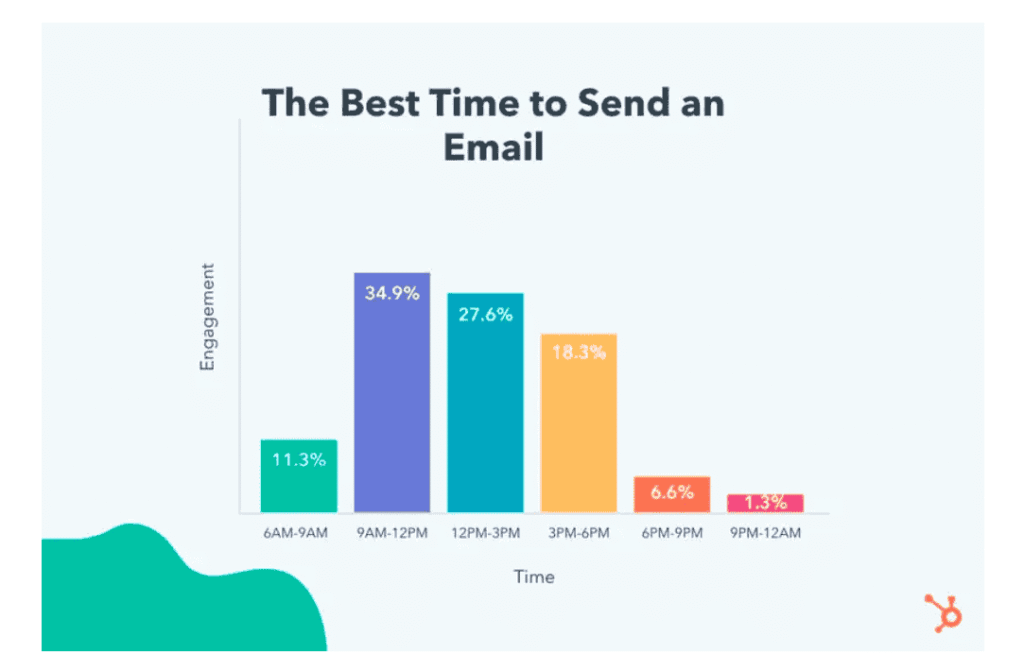
The best time to send marketing emails depends heavily on who your subscribers are and how their daily life looks. A nurse, a student, and a corporate manager do not check email at the same moments.
B2B (Business‑To‑Business) Email Timing
B2B subscribers mostly use email during work hours and often check it on desktop.
- Best days: Tuesday, Wednesday, Thursday.
- Best times:
- 9–11 a.m. local time, with a very common sweet spot around 10 a.m.
- 2–4 p.m. local time for nurturing and reminder emails.
Use these windows for:
- Webinar and demo invitations.
- Case studies, whitepapers, and lead magnets.
- Onboarding, feature education, and product tips.
B2C (Consumer) Email Timing
Consumers are more likely to read emails on mobile and outside strict office hours.
Common winning times for B2C:
- Best days: Thursday, Friday, and sometimes Sunday.
- Best times:
- 4–8 p.m. local time, when people are relaxing, browsing, or shopping online.
- Friday evenings and Sunday mornings for offers, discounts, and product promotions.
Use these slots for:
- Sales and discount campaigns.
- Product launch announcements.
- Cart recovery and post‑purchase offers.
Newsletters And Content‑First Emails
Newsletters and educational emails work best when subscribers have time to read, not just skim.
Helpful patterns:
- Professional and educational newsletters:
- Monday or Tuesday, often late afternoon (around 4–6 p.m.), when people plan and learn.
- Lifestyle, hobby, and inspiration newsletters:
- Weekend mornings can work well because people are relaxed and open to new ideas.
Launches, Campaigns, And “Last Chance” Emails
Launches and big promotions often combine several timing slots.
A simple pattern you can use:
- First announcement: morning (7–10 a.m.) on Tuesday or Thursday.
- Reminder: afternoon (1–4 p.m.) when people have time to act.
- Final “last chance” email: evening on the last day, when urgency is highest.
Time Zones, Countries, And Global Lists

If your subscribers are in different time zones, one fixed sending time will always be bad for someone. This is a key point for international brands and affiliate marketers.
Important time zone tips:
- Use local time sending: Many email tools let you send at, for example, 10 a.m. in each subscriber’s local time. This automatically respects their workday or daily routine.
- Segment by region: If you cannot send by exact time zone, at least segment your list into regions such as North America, Europe, Africa, and Asia‑Pacific, and send separate campaigns.
- Respect local weekends and holidays: Weekends and public holidays are different across countries, and this can change your best sending times.
For cold outreach and B2B, respecting local office hours also increases replies and shows professionalism. Best Days To Send Marketing Emails
How To Find The Best Time To Send Marketing Emails For Your Own List
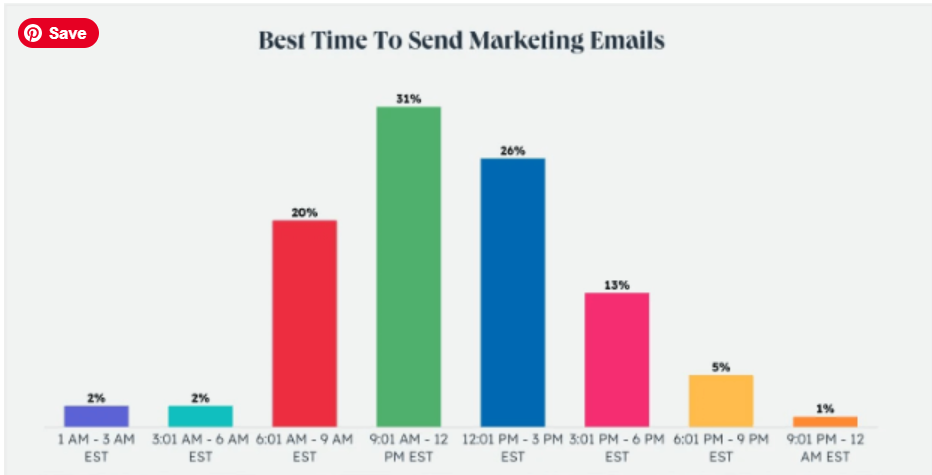
Research is only a starting point. Your real best time comes from watching your own metrics and running simple experiments.
Step 1: Pick One Strong Default Time
Choose a data‑backed default that matches your main audience:
- Mixed or general list: Tuesday or Thursday, 9–11 a.m. local time.
- Mostly B2B: Tuesday, 10 a.m. local time.salesforce+2
- Mostly B2C: Thursday or Friday, around 6 p.m. local time.
Use this same time for your next 3–5 campaigns so you have a clean baseline of open rates, clicks, and conversions.t
Step 2: Track The Right Metrics
When you test timing, you need to look at more than just opens.
Focus on:
- Open rate: Tells you whether your email lands in the inbox at a good time for attention.
- Click‑through rate (CTR): Shows if people are in a mindset where they can take action.
- Conversion rate: The most important metric for promotions, showing if timing affects sales, signups, bookings, or replies.
Modern email tools show these metrics per campaign and sometimes per segment, making comparison easy.
Step 3: Run Simple A/B Tests On Send Time
Keep your tests simple. Change only the send time and keep everything else the same: subject line, content, and audience segment.
Example A/B test:
- Version A (control): Tuesday, 10 a.m.
- Version B (variant): Tuesday, 4 p.m.
Send each version to a similar‑sized segment and wait 24–48 hours. Then compare open rate, CTR, and conversions.
Repeat this with different days and hours until you see a clear pattern. Keep the winning day and time as your new default.
Step 4: Segment And Personalize Over Time
As your list grows, your “one best time” might split into several best times for different groups.
Useful segments for timing:
- Time zone or region (for example, US vs Europe vs Africa).
- Subscriber type (lead vs customer, free vs paid, new vs long‑time).
Highly engaged subscribers might receive campaigns more often at peak times, while colder segments might get fewer but highly relevant emails at proven high‑engagement windows.
Step 5: Use Send‑Time Optimization And AI Features
Many email platforms now include “send time optimization” or AI‑driven delivery. These tools analyze each subscriber’s past behavior and choose the hour when they are most likely to open.
These features usually:
- Study historical open and click data for each contact.
- Predict a personal best time window for engagement.
- Automatically stagger your send, so each subscriber gets your email at their own best time.
This can increase opens and clicks without extra manual testing on every campaign.
Common Mistakes With Email Timing (To Avoid)
Even with strong content, timing mistakes can quietly kill your results.
Avoid these common errors Best Days To Send Marketing Emails:
- Sending all campaigns Monday morning, when people are stressed and cleaning their inbox.
- Ignoring weekend performance when your own data clearly shows strong Saturday or Sunday engagement.
- Sending to a global list at one fixed time with no time‑zone logic.
- Changing times randomly every send, so you never build clear data.
- Copying another brand’s sending schedule without testing it on your own subscribers.
Treat your sending time like an ongoing experiment. Keep what works, remove what does not, and update your strategy as your list grows.
Conclusion: The Best Time To Send Marketing Emails Is Data + Context

There is no single “perfect minute” for every business, but there is a smart path to discover the best time to send marketing emails for your audience.
You can use current research as your starting point:
- Strong baseline: Tuesday or Thursday between 9 and 11 a.m. local time for many lists.
- B2B: weekday mornings around 10 a.m. for nurturing and educational content.
- B2C: late afternoons and evenings, especially Friday evenings and Sunday mornings, for offers and promotions.
- Always respect time zones and use local send times whenever possible.
From there, your own tests, metrics, and segments will show you when your subscribers actually want to hear from you. If you keep listening to the data and adjusting, your timing will improve—and your opens, clicks, and revenue will follow.